

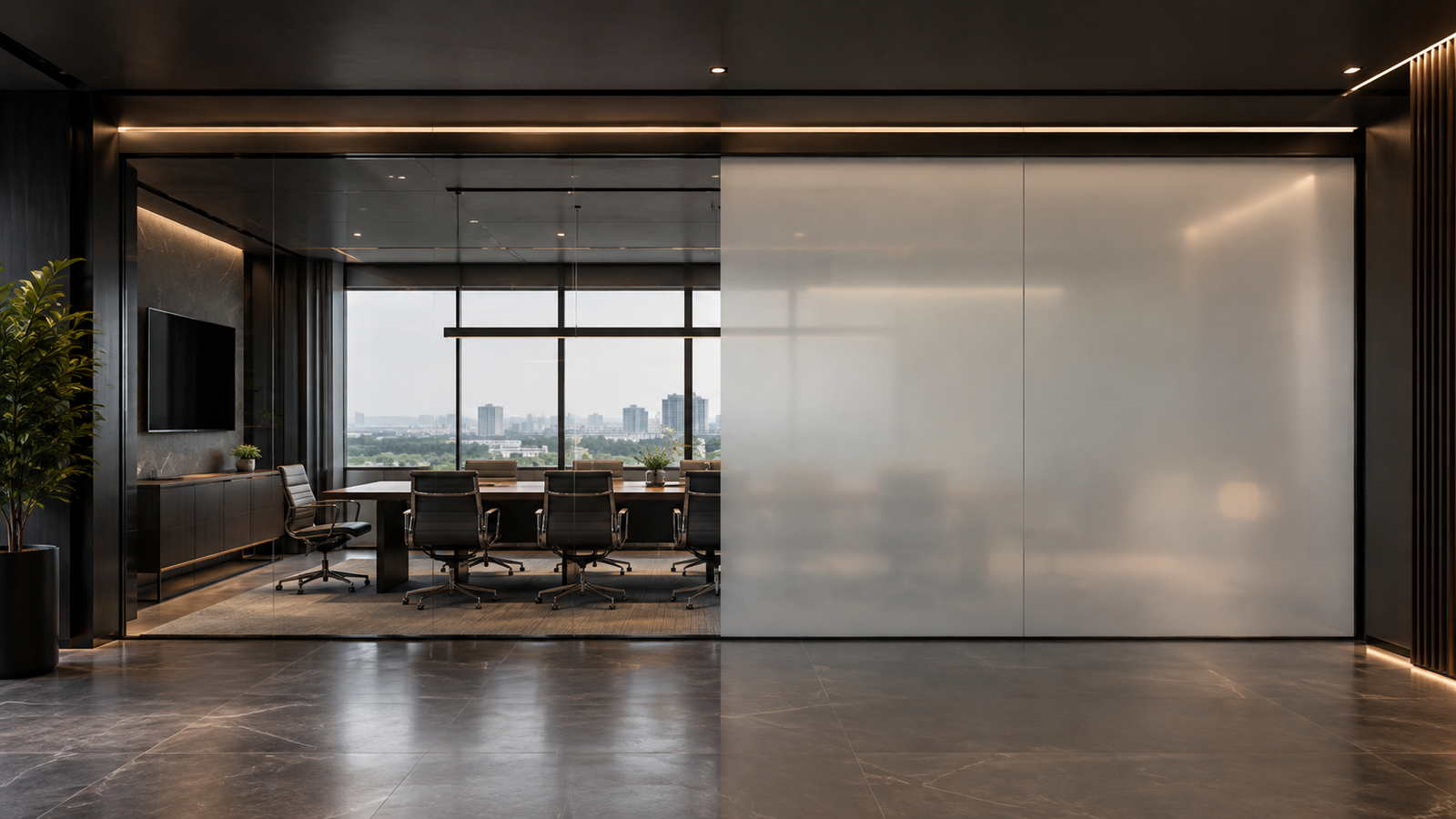
Picking the right privacy solution for your home or office can feel like a bigger decision than it should be. Frosted glass has been the go-to choice for decades, but a newer contender is changing how architects and homeowners think about privacy altogether: smart glass. If you’ve been comparing smart glass vs frosted glass and wondering which one deserves a spot in your next renovation or build, you’re in exactly the right place. This guide breaks down how switchable glass (also called PDLC glass) stacks up against traditional frosted glass across privacy, maintenance, cost, and design flexibility, so you can make a confident choice for your space.
At Royal Tint, we specialize in advanced Switchable Smart Glass and PDLC Film solutions that combine privacy, elegance, and intelligent functionality for modern environments.
Quick Summary
- Smart switchable glass switches between clear and frosted on demand, while traditional frosted glass stays permanently opaque.
- PDLC (Polymer Dispersed Liquid Crystal) technology powers switchable glass, letting it flip states in under 50 milliseconds.
- Frosted glass is cheaper upfront, but smart glass offers better long-term flexibility, light control, and a more modern aesthetic.
- Switchable glass suits offices, conference rooms, bathrooms, and healthcare settings where privacy needs change throughout the day.
- Retrofitting existing glass with self-adhesive PDLC film is faster and less disruptive than replacing glass with frosted panels.
What’s the Difference Between Smart Glass and Frosted Glass?
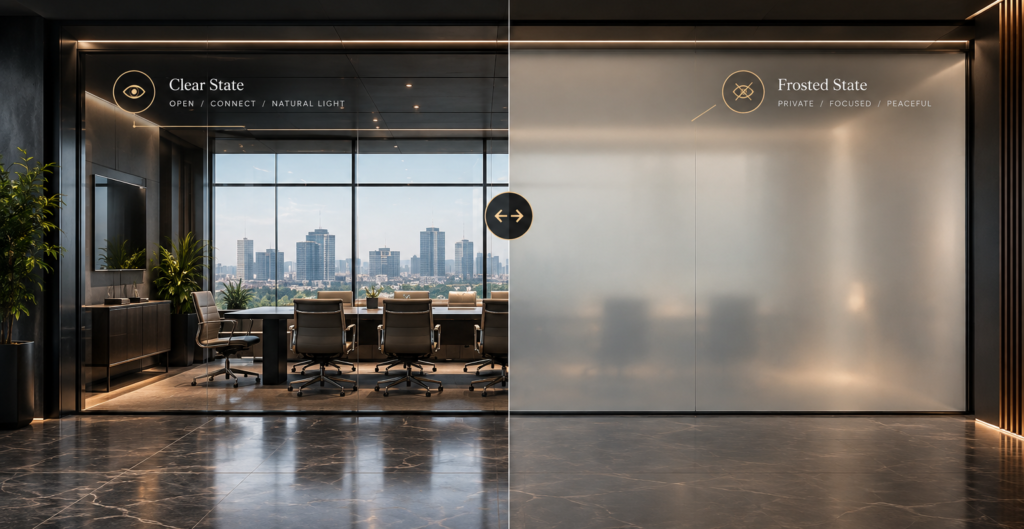
Smart glass, often called switchable glass, uses PDLC technology to change from transparent to frosted with the flip of a switch. Traditional frosted glass, on the other hand, achieves its opaque look through a permanent physical or chemical process, like sandblasting or acid etching, and it stays that way forever.
That single difference, permanent versus adjustable, is what separates these two products in almost every practical sense. Frosted glass gives you one fixed level of privacy, all day, every day. Smart switchable glass gives you the choice to open up a room for natural light or seal it off for a private conversation, all without touching a blind, curtain, or sticker.
Both products create a similar diffused, private appearance when smart switchable glass is switched to its frosted state. But the technology behind that appearance, and what it means for how you actually use a room, couldn’t be more different.
How Does PDLC Smart Glass Actually Work?
PDLC smart glass works by suspending liquid crystal droplets in a polymer film sandwiched between two layers of glass or applied as a film. When electricity runs through this layer, the crystals align and let light pass through, making the glass clear. Cut the power, and the crystals scatter randomly, scattering light and turning the glass frosted and private.
This switch happens in under 50 milliseconds, so the transition from clear to frosted feels instantaneous. It’s the same core science whether you’re looking at:
- Self-adhesive PDLC film, which sticks directly onto your existing glass for quick retrofits
- Laminated smart glass, where PDLC film is sealed between two tempered glass panes during manufacturing, built for new construction or full glass replacement
One helpful detail worth knowing: PDLC smart glass defaults to frosted (private) when the power goes out. There’s no risk of accidentally losing privacy during an outage, which is a common concern for first-time buyers exploring switchable privacy glass for offices or homes.
Smart Glass vs Frosted Glass: Side-by-Side Comparison
Here’s how switchable glass vs traditional frosted glass compares across the factors that matter most for modern interiors.
| Feature | Smart Glass (PDLC) | Traditional Frosted Glass |
|---|---|---|
|
Privacy control
|
Adjustable on demand, clear or frosted with a switch |
Fixed and permanent, always frosted |
|
Light transmission
|
Maintains roughly 75% light transmission when clear |
Reduced light at all times, even when privacy isn’t needed |
|
UV protection
|
Blocks up to 99% of UV rays | Limited UV protection |
|
Installation
|
Retrofit film in as little as one day, or laminated glass for new builds |
Requires new glass, sandblasting or etching, often more disruptive |
|
Maintenance
|
Easy wipe-clean surface, low upkeep |
Easy to clean but can show smudges more visibly over time |
|
Automation
|
Compatible with voice assistants, sensors, and building automation systems |
No automation options available |
|
Lifespan
|
8 to 12 years, rated for 50,000+ switching cycles |
Permanent, but appearance can degrade with scratches over time |
|
Aesthetic
|
Clean, seamless, and architecturally modern |
Classic and familiar, but static |
When Should You Choose Smart Glass Over Frosted Glass?
Smart glass makes the most sense whenever a space needs to serve two purposes: openness at some moments and privacy at others. If your room’s use changes throughout the day, switchable glass is worth the investment over static frosted glass.
Here are situations where smart glass for modern interiors clearly outperforms traditional frosted glass:
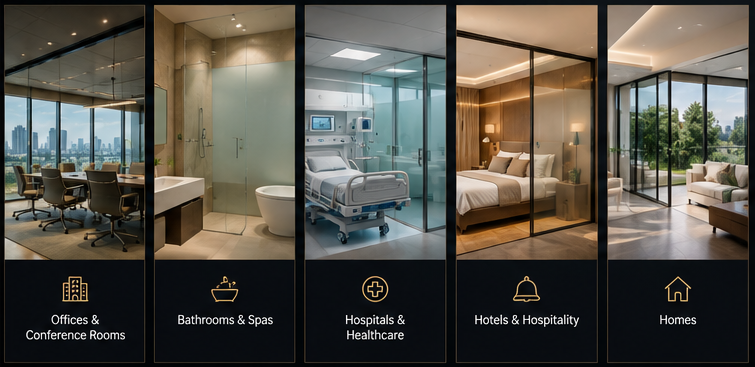
- Conference rooms and offices: A boardroom can stay glass-walled and open for most of the day, then switch to private the moment a sensitive meeting begins. Some installations even double as a built-in projection screen, eliminating the need for a separate display.
- Bathrooms and spa spaces: Smart switchable glass for bathrooms allows natural light to flow in when the space is unoccupied, then switches to full privacy at the flick of a switch.
- Healthcare settings: Hospitals increasingly favor switchable glass over fabric curtains, which trap dust and pose infection control risks. PDLC glass wipes clean and gives patients dignity on demand.
- Retail and hospitality: Showrooms use smart glass to create VIP consultation rooms during the day and eye-catching frosted displays after hours.
- Homes with flexible layouts: Balcony dividers, home theaters, and skylights all benefit from glass that adapts to the moment, whether that’s blocking harsh afternoon sun or creating an intimate movie night.
When Does Traditional Frosted Glass Still Make Sense?
Frosted glass still has a place, particularly in budget-conscious projects or spaces where privacy needs never change. If a bathroom window or office partition needs constant, uncompromising privacy and there’s no benefit to ever having it clear, permanent frosted glass or film can be the simpler, lower-cost choice.
It’s also a familiar, well-understood product with a long track record. For property owners who aren’t ready to invest in automation or electrical fit-out, frosted glass remains a straightforward option, even if it lacks the flexibility of smart glass for offices and homes.
What Are the Advantages of Smart Glass Over Frosted Glass?
The advantages of smart switchable glass over frosted glass come down to control, comfort, and long-term value.
- On-demand privacy: You decide when a room feels open and when it feels private, rather than committing to one look permanently.
- Better light management: Switchable glass lets in significantly more natural light when clear, reducing the need for artificial lighting during the day.
- Energy efficiency: Blocking up to 99% of UV rays helps reduce heat gain, which can lower cooling costs in sunlit rooms.
- Smart home and office integration: PDLC glass connects to voice assistants like Alexa, Siri, and Google Assistant, as well as building automation systems, so privacy can be scheduled or triggered by sensors.
- A cleaner, more modern look: Without cords, blinds, or curtains, switchable glass partitions create seamless, architecturally clean sightlines that many designers prefer for contemporary interiors.
- Long-term durability: Rated for over 50,000 switching cycles, quality PDLC glass is built to perform reliably for 8 to 12 years.
Is Smart Glass More Expensive Than Frosted Glass?
Yes, smart switchable glass generally costs more upfront than traditional frosted glass, largely because of the PDLC film technology and, in some cases, the electrical wiring required for laminated installations. However, this comparison shifts when you factor in what each option delivers over time.
Frosted glass offers one fixed function for its entire lifespan. Smart switchable glass offers adjustable privacy, UV protection, energy savings, and even a projection surface in some setups, all from a single installation. Choose frosted glass if your budget is tight and your privacy needs are simple and unchanging. Choose smart switchable glass if the room’s function will vary, or if the long-term flexibility and modern aesthetic matter more than the initial price difference.
Can You Retrofit Smart Glass Onto Existing Windows?
Yes. Self-adhesive PDLC film can be applied directly onto existing glass without removing or replacing it, which makes retrofitting far less disruptive than installing new frosted glass panels. Most single-site installations are completed within a day, with no demolition and no visible bulk since the film is just a fraction of a millimeter thick.
This makes switchable film a practical option for renters, businesses that can’t afford downtime, or anyone upgrading a space without a full renovation. If you’re curious about how to keep switchable glass performing well after installation, our guide on how to maintain and clean switchable smart glass walks through the simple upkeep involved.
Choosing Between Smart Glass and Frosted Glass for Your Next Project
Every interior has its own rhythm. Some rooms need one fixed look forever, and frosted glass handles that job well and affordably. But if your space shifts between open and private throughout the day, whether that’s a conference room, a home office, or a hospital ward, smart privacy glass offers a level of control that frosted glass simply can’t match.
The best next step is seeing the difference for yourself. Compare a frosted sample against a PDLC switchable film sample side by side, and the flexibility becomes obvious almost immediately. Explore our full range of switchable glass and switchable film options, or browse our library of resources to see how other homes and businesses have made the switch.